My Mentorship
I firmly believe in the importance of mentorship, which fosters personal and professional growth by providing new guidance, support, and opportunities for both the mentor and their students.
My mentorship began seven years ago and continues to this day. Most of it was done through the Cybertronics Robotics Club and FRC teams 7435, 8069, and 931, and I treasure every moment of it. During all this time, I met many children who never built anything more than LEGO kits, not even real robots. I am so thrilled that I was able to introduce young children to LEGO MINDSTORMS and LEGO WeDO systems, as well as to VEX IQ, providing them with hands-on, valuable experience during the summer camps and through afterschool robotics classes. Besides mentoring elementary-age students, I had the opportunity to work with teens during robotics boot camps and to share my technical expertise with new team members with no prior engineering experience.
I’ve included some highlights of my mentorship journey below.
Mentoring with FRC team 931
Having been involved with robotics for many years, I have developed a wide range of skills, from soldering to operating an industrial-grade CNC router, which I’ve used to create parts for my robotics team. I’m passionate not only about robotics but also about teaching others. I always look forward to the opportunity to share my skills with them. I like to adopt a hands-on approach, not only showing how to do something but also making sure they understand it and can recreate and transform the techniques into their own.
Along with being a member of FRC 931, I simultaneously joined their FTC team, 288 SpareParts, to mentor and inspire FTC students to use advanced building techniques learned through my FRC experience and apply them to their smaller FTC robot.
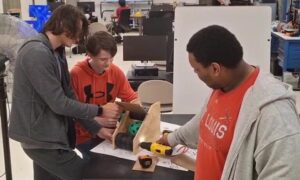
Working with new members on building a robot shooting mechanism
Mentoring with FRC team 8069
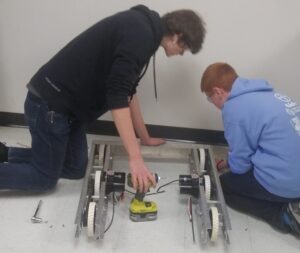
Advising a new team member on putting the drive train together
As one of the most experienced team members in robot building, I took the initiative to train new members by sharing my technical skills, helping them become ready to achieve greater seasonal goals.
I took on the leadership role on our drive train team. I led new members through the assembly and programming of a simple yet relatively effective drive train. Most importantly, it was an opportunity for students to learn about basic drive trains and how to achieve the desired results.
Besides mentoring in-house members, my team and I participated in many STEM outreach events, including homeschool fairs ( most members on my team were homeschooled students), St. Louis Science Center “Science Fest”, and many others, where we were demonstrating our robot and teaching middle school pupils how to make simple mechanisms.
Mentoring with FRC team 7435
As a Mentor, I pass on my skills and expertise while developing communication, problem-solving, and leadership skills. I am a big advocate of FAIL, or First Attempt In Learning, to build my students’ confidence in their skills and abilities. It is a win-win situation for both.
I enjoyed sharing what I know with different people, whether it was a group of young mentees from a local Boys & Girls Club or an avionics student from South America who wanted to learn to pilot our FRC competition robot.
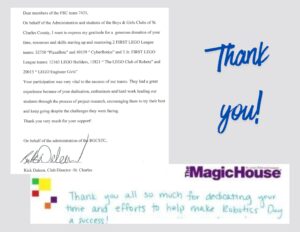
Over 3 years, my team and I mentored several FIRST teams and encouraged many children to get involved in STEM. We received multiple thank-you letters and cards appreciating what we have done for the community.

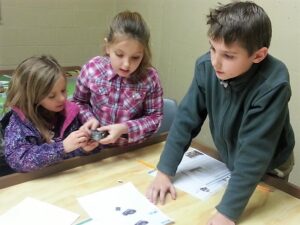
Explaining how to read diagrams
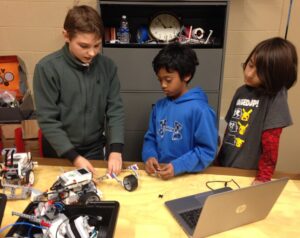
Explaining mechanical principles

Summer camp robotics class
Mentoring with FTC team 13023
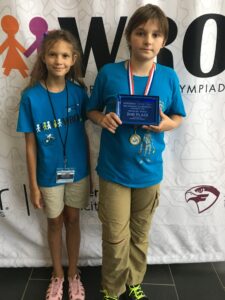
Second Place Robot Design Award
I mentored several FLL and Jr. FLL teams, but the highlight of my teaching in the yearly age group was associated with the World Robot Olympiad. My team and our Robotics Club were hosting the first qualifying Regional event for the World Robot Olympiad, held in Missouri. Besides competing myself, I took the initiative to help our youngest team, “Skating Polar Bear,” get ready for the event.
My mentees brainstormed robot design ideas to create a simple, easy-to-assemble bot that can complete all the missions in a single run. They used LEGO WeDo to build and program their robot. All the hard work paid off, and my students took first place at the Regional.
The next step for them would be the National Competition in West Virginia. One team member was unable to travel, so only two girls participated.
The event was very intense, but my mentees did very well. They placed second in robot design and sixth in autonomous navigation nationally, something I am very proud of.